
Good questions. Straight answers.
For performance directors, strength coaches, sports scientists, clinicians, and buyers who already have VALD and want the data to mean something every day.
What is Starke Force?
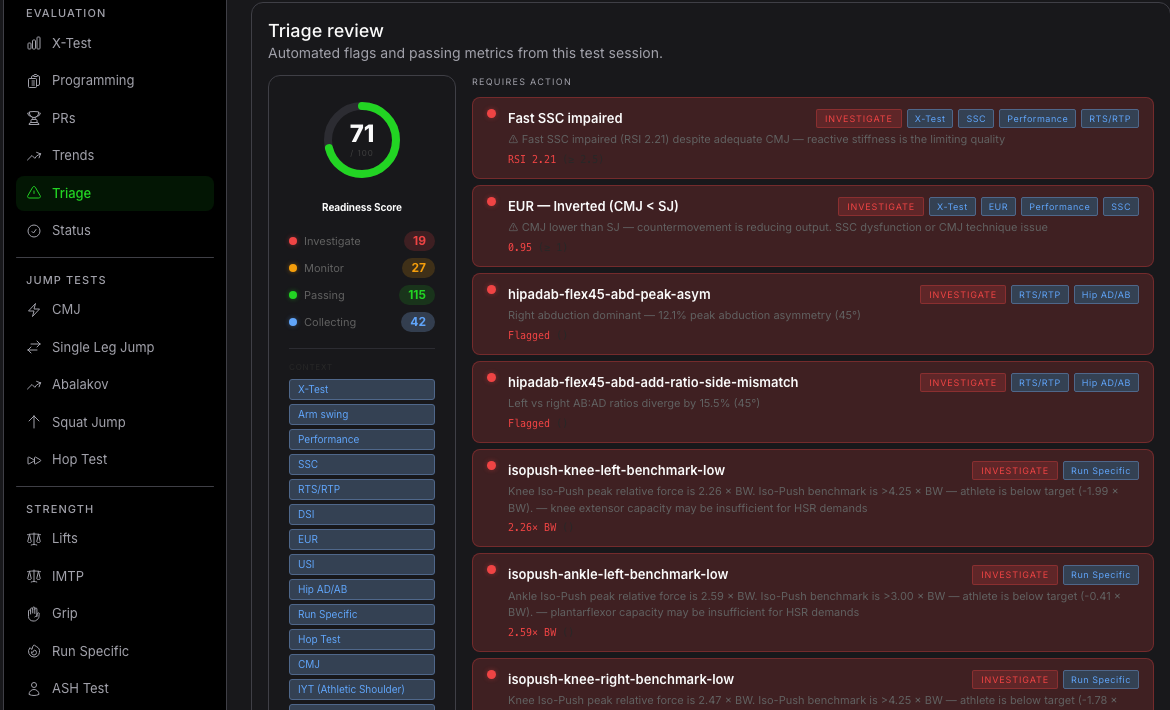
Starke Force is a sports performance analytics platform for organizations that run force-plate and strength testing, primarily through VALD ForceDecks, Dynamo, and Force Frame. It ingests test data, runs automated analysis, surfaces severity-ranked triage flags, and connects findings to intake-aware AI programming in one athlete record.
Who is it for?
Performance centers, collegiate and professional sport organizations, and clinical sport teams with multiple practitioners and athletes. Users include org administrators, strength coaches, sports scientists, athletic trainers, physiotherapists, and athletes.
Do we need VALD equipment?
Starke Force ships deep VALD integration today. Most customers use ForceDecks; many also use Dynamo or Force Frame. You do not need every VALD product. Enable only what your facility owns. Manual assessments are available without plates.
How is this different from VALD's own software?
VALD devices and cloud services collect and present test data. Starke Force extends that investment with automated triage across tests, cross-test Overview, org-wide interpretation workflows, athlete-facing explanations, and flag-driven programming unified per athlete.
We already have VALD. Why add this?
Good. Starke Force is how the organization turns VALD output into daily decisions at roster scale. It replaces the manual layer between test completion and the morning meeting: spreadsheets, inconsistent threshold interpretation, and disconnected programming docs.
Will staff adopt another tool?
The testing workflow stays the same. Trainers keep using VALD hardware. Starke Force adds nightly sync, triage on dashboard open, and programming on the same athlete profile. The adoption hook is simple: less chart archaeology.
What does a pilot or evaluation look like?
Usually one organization, one team or subgroup, and one or two staff leads to start. The evaluation focuses on real workflow fit: ingest, triage review, athlete profiles, and whether Starke Force improves the path from test completion to daily decisions.
How long does onboarding take?
That depends on roster size, athlete linking, and how quickly your staff want to move, but onboarding is meant to be practical: configure equipment, link athletes, confirm team structure, and train the initial staff leads on triage and review workflows.
Can we start with one team or subgroup?
Yes. For many organizations that is the best way to evaluate fit before expanding. Starke Force supports team and subgroup structure so you can start narrow and learn from real use.
Is AI programming risky?
It would be if it were open-ended chat. Starke Force uses flag-driven playbooks, a curated exercise allowlist, equipment and pain filters, and a mechanical validator. Coaches and clinicians still own all loading decisions.
Can athletes understand the results?
Yes. Athletes see simpler explanations than coaches. They do not see coach prescription text. Daily check-in, PRs, leaderboards, and plain-language tooltips are designed for comprehension rather than data-entry busywork.
What about data security?
Marketing-safe answer: role-based access, organization boundaries, encrypted HTTPS, separate operator and athlete/coach surfaces, and 2FA available for highest-privilege accounts. Enterprise buyers can request a deeper security brief during evaluation.
Does Starke Force stream live force-plate data?
No. Data flows through fetch and nightly sync. Analysis runs at ingest so dashboards load with triage already computed.
Can we reprocess old tests when rules change?
Yes. Raw trials are retained so summaries and analysis can be rebuilt from stored data when methodology evolves.
How is pricing structured?
Starke Force uses organization licensing. Public pricing is not published. Request a pilot walkthrough to discuss scope, equipment mix, roster size, and onboarding needs.
Starke Force supports training and monitoring decisions. It does not diagnose injury, replace clinical examination, or provide medical clearance.