01
Connect
Set up the VALD equipment your facility actually owns, link athletes, and map teams, subgroups, and staff roles.

Starke Force is built for organizations already using VALD who want faster triage, more consistent staff interpretation, and a cleaner handoff from testing to programming.
The point is not more analytics theater. The point is helping coaches, sports scientists, and clinicians start the day with the same signal and act on it faster.
Linked athlete tests are discovered, retried when needed, analyzed, and summarized.
Overview flags show systemic readiness depression, asymmetry, or profile changes before the day starts.
Programming recommendations use flags, daily check-in, athlete equipment, pain modifiers, and coach input.
ROM, H-Force, respiratory/aerobic, and ArmCare assessments live beside the force data.
PRs, trends, leaderboards, and plain-language explanations keep the work connected.
Set up the VALD equipment your facility actually owns, link athletes, and map teams, subgroups, and staff roles.
Keep using your current testing process. Fetch tests on demand or let nightly sync keep the roster current. Manual assessments are available anytime.
Per-test tabs and Athlete Overview compute metrics, trends, flags, and normative context at ingest so staff are not rebuilding context by hand.
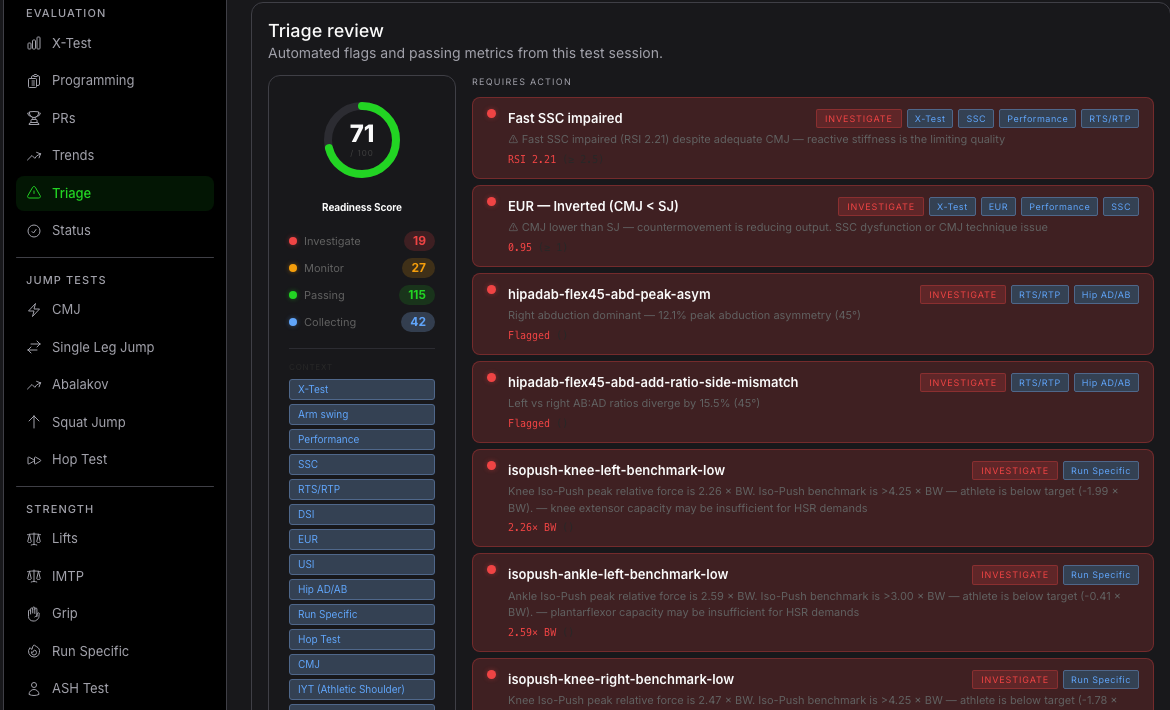
Investigate, monitor, and passing flags give coaches, sports scientists, and clinicians the same shortlist of what deserves attention.
Flag-mapped playbooks and intake-aware AI assist with session construction under guardrails, keeping programming attached to testing instead of separate docs.
Leaderboards, PRs, daily check-ins, and athlete communication help the organization follow through after the test session ends.
Early evaluations can begin with one organization, one team or subgroup, and one or two staff leads. The goal is to prove that Starke Force improves the workflow between test completion and daily decisions in your actual environment.
Staff keep their testing habits. What changes is the review layer: triage arrives faster, interpretation gets standardized, and programming handoff stays tied to the athlete record.
Org admins configure structure. Trainers fetch, triage, and program. Sports scientists review methods. Clinicians track asymmetry and manual screens. Athletes check in, understand results, and see progress. The whole point is one shared operating picture across roles.
The ingest worker downloads raw trials, maps them to canonical format, runs analysis, and writes ready-to-read results. That is why triage appears without waiting on math and why the morning review can start with decisions instead of spreadsheet cleanup.
Request a pilot walkthrough to review triage, athlete profiles, and the programming handoff in the context of a VALD-equipped organization.