Per-test specs
Major test types have written analysis rules: metrics at ingest, interpretation logic, flag IDs, and severity levels.

Starke Force uses documented analysis rules, literature-backed thresholds where applicable, raw trial retention, and editable clinical copy. When a flag says investigate, a defined condition fired.
Major test types have written analysis rules: metrics at ingest, interpretation logic, flag IDs, and severity levels.
DSI, EUR, SSC, arm swing, baseline deviation, and composite readiness answer questions a single test cannot.
Force-time trials are stored so summaries can be rebuilt when methodology improves.
Overview combines tests within the organization comparison window, defaulting to 7 days, to explain profile and readiness.
CMJ peak force divided by IMTP peak force. It helps separate strength-dominant, balanced, and ballistic-dominant profiles.
CMJ height divided by squat jump height to show stretch-shortening cycle use and programming bias.
Slow and fast stretch-shortening signals can fail separately. Full failure points to a broader elastic deficit.
Abalakov jump height compared with CMJ height to show upper-body contribution.
Recent results compared with rolling personal baselines to separate readiness troughs from long-term profile.
When IMTP relative force falls below documented floor, jump metrics may be unreliable for clearance decisions.
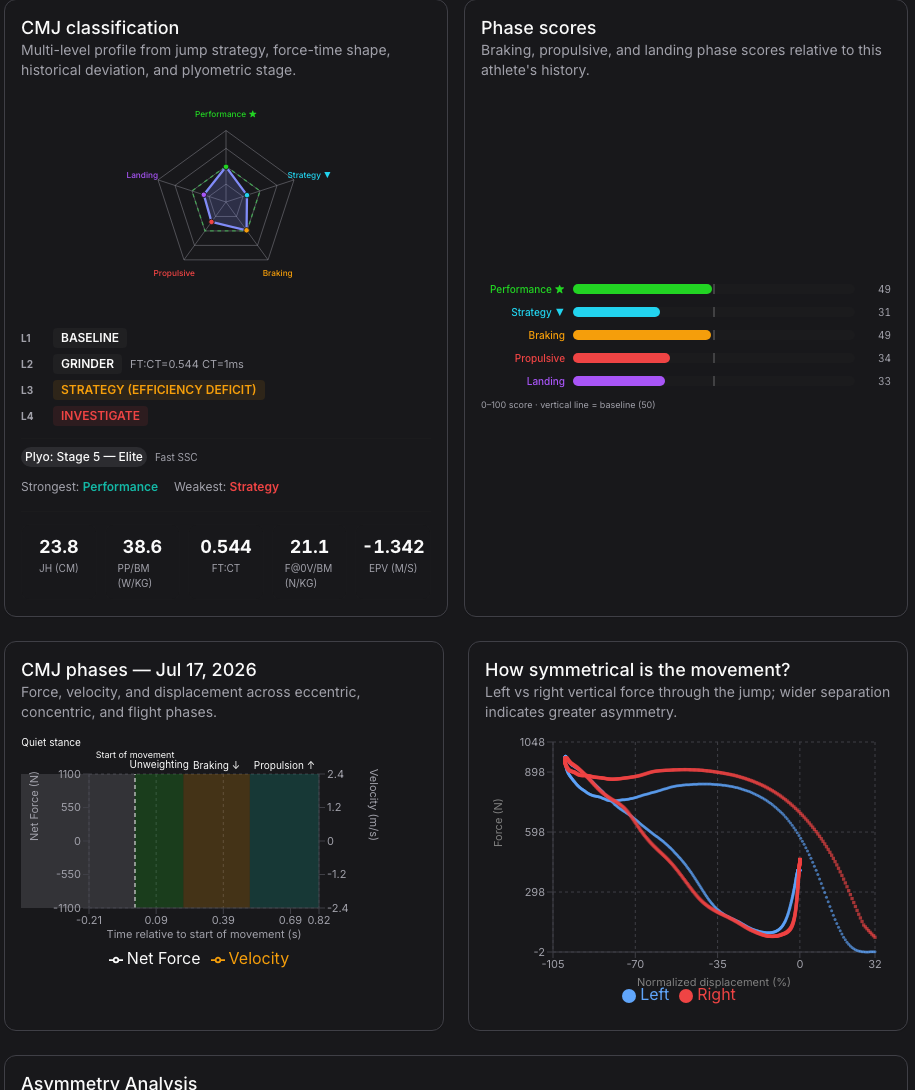
Countermovement jump analysis in Starke Force can include force/work-loop style views, phase segmentation, classification, and symmetry context. That matters when similar jump heights come from very different movement strategies.
IMTP and grip use VALD Practitioner Guide percentile anchors stratified by sex and age band. Norms provide population context. Personal baselines and triage flags still drive the daily decision.
| Severity | Staff meaning |
|---|---|
| Investigate | Act or clarify before progressing load as planned. |
| Monitor | Watch; may influence programming emphasis. |
| Passing | Context; not the main action driver. |
| Collecting baseline | Not enough history yet. Honest uncertainty beats false alarms. |
Coaches see threshold detail, clinical interpretation, and programming actions. Athletes see simplified explanations without prescription instructions. Operators can edit both sides in administration.
Programming recommendations are flag-driven, allowlist-constrained, validator-enforced, and intake-aware. Severely degraded readiness defers to coach review.
AI-generated training suggestions are not medical advice. They support, not replace, coach and clinician judgment.
Walk through the rules, thresholds, and governance model with the team.